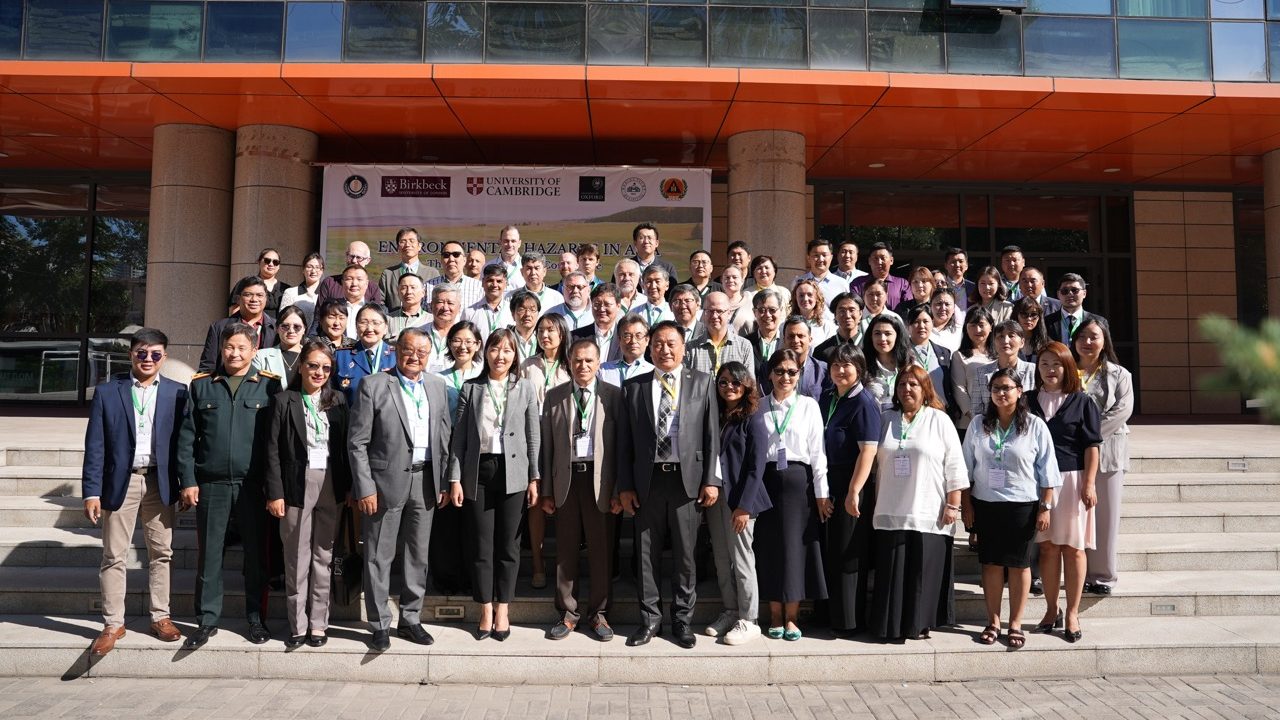
In collaboration with colleagues at the Mongolian Academy of Science and the University of Oxford, we organised a conference on Environmental Hazards in Asia in Ulaanbaatar, Mongolia in August 2023. The meeting brought over 100 research scholars, academics, government officials, and students, representing a wide age range from 20 to 60. Notably, 37 researchers from over 20 countries—including the UK, China, Japan, Korea, Russia, Turkey, Mongolia, the Philippines, Nepal, India, Afghanistan, the USA, Sri Lanka, Iran, and Azerbaijan—presented their work. A detailed report can be found here.
The key recommendations from the conference are listed below:
- Studies into environmental hazards should not be done in isolation. Every hazard is a multi-hazard, requiring an understanding of the interplays between natural processes, human related impacts and how different hazards impact each other. There are no such thing as natural disasters, rather the impacts of environmental hazards are determined by our vulnerability to them. It means, social sciences working to characterize these vulnerabilities need to coordinate with natural sciences working to understand the hazards themselves. Networking events, such as this conference are key in building resiliance to future hazards.
- Our ability to provide hazard assessments are only as good as the data underpinning them. In many areas, we are lacking data at the spatial and temporal level required to produce effective hazard assessments. Data collection and analysis must be performed before the disaster, not just in reaction to an event. A funding model to support this, involving national and international organisations is required. It also means sharing data, software, and best practices needs to be as open as possible.
- Disaster management should be as decentralised as possible. Local communities need to play a central role to ensure the effectiveness of mitigation strategies. Identifying and supporting local actors who can lead change within their communities and help develop pragmatic, effective solutions is essential.
- Education is the cornerstone of effective disaster risk reduction. Environmental hazards, their interplay and the impacts of a changing climate should be embedded in school curriculum. Education on hazards should start as early as possible and all sectors from early years, through school, university and beyond should cooridntate their approaches to education to reinforce key messages. Training and support is important for researchers and those working in DRR. It encourages groups to work outside their silos and develop interdisciplinary partnerships.
- The meeting benefited from having a wide cross section of experience, including those working in development, education, policy makers, diplomats and politicians as well as researchers. We benefited from having representatives from Rio Tinto, Oyo Tolgoi, NEMA, the Mongolian Parliament, UNDP and UNICEF. It would be good to include more, including engineers, members of civil society and funding agencies to highlight challenges and obstacles to effective disaster risk reduction.
The conference demonstrated that there is a dedicated community of hazard researchers across Asia and beyond, eager to take action on these recommendations. While funding remains a challenge, regular meetings that bring together researchers and practitioners will help build strong, interdisciplinary relationships, facilitate data sharing, and foster the development of research proposals for future projects. We propose to hold a second international meeting on Environmental Hazards in Asia in Ulaanbaatar in August 2026 and develop this into a regular biannual meeting.
A video showing highlights from the conference can be seen below
 themprc.org